Architecture
CUSTOMHyS is organised into a hierarchy of modules that mirror the three levels of the hyper-heuristic methodology: low, mid, and high level heuristics.
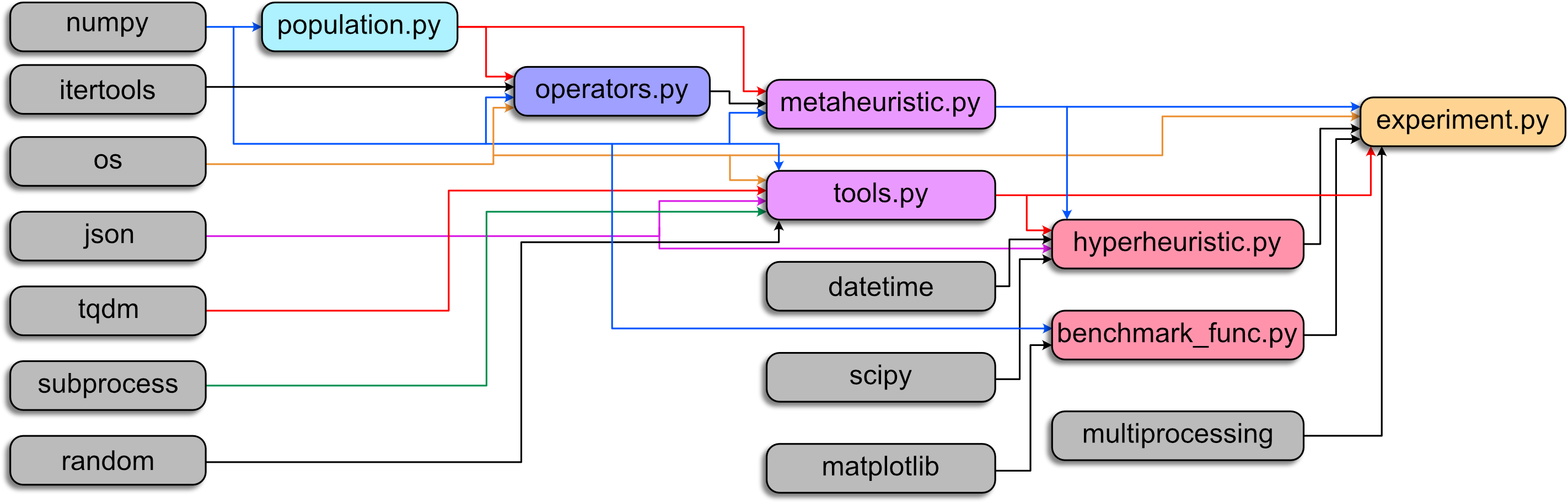
Module Overview
🤯 Benchmark Functions (benchmark_func)
A library of N-dimensional continuous benchmark functions used to evaluate optimisation
methods. Every function is implemented as a class with a unified interface
(get_func_val, get_search_range, get_optimal).
The catalogue includes classical families such as Ackley, Rastrigin, Rosenbrock,
Schwefel, Griewank, and many more — plus the CEC 2005 suite when the optproblems
package is available.
from customhys import benchmark_func as bf

func = bf.Rastrigin(10)          # 10-dimensional Rastrigin
bounds = func.get_search_range() # ([-5.12, ...], [5.12, ...])
f_opt  = func.get_optimal()      # known global minimum value
Source: customhys.benchmark_func
👯♂️ Population (population)
A Population object represents a set of agents in a search space. It manages
positions, velocities, fitness values, and selection mechanisms. Populations do not
decide how to move — that is the job of search operators — but they know when to
accept a new position via a selector (greedy, metropolis, probabilistic, or all).
Key responsibilities:
Initialise agents with different schemes (random, Sobol, Halton, LHS, …)
Evaluate fitness for all agents
Update global / particular / population best positions
Constrain agents to the feasible domain
from customhys.population import Population

pop = Population(boundaries=([-5]*10, [5]*10), num_agents=30)
pop.initialise_positions("random")
Source: customhys.population
🦾 Search Operators (operators)
A collection of 13 search operators (perturbators) extracted from well-known metaheuristics. Each operator is a function that modifies the population’s positions in place. Operators are the building blocks that the hyper-heuristic combines to assemble new metaheuristics.
Available operators:
Operator |
Alias |
Origin |
|---|---|---|
|
RS |
Random Search |
|
RX |
Random Sampling |
|
RF |
Lévy Flights |
|
RW |
Random Walk |
|
CF |
Central Force Optimisation |
|
DM |
Differential Evolution |
|
FD |
Firefly Algorithm |
|
GC |
Genetic Algorithm |
|
GM |
Genetic Algorithm |
|
GS |
Gravitational Search |
|
SD |
Spiral Dynamics |
|
PS |
Particle Swarm Optimisation |
|
LS |
Linear System |
Each operator is paired with a selector that decides how agents accept the
proposed move: greedy, all, metropolis, or probabilistic.
("swarm_dynamic", {"self_conf": 2.54, "swarm_conf": 2.56, "version": "inertial"}, "greedy")
Source: customhys.operators
🤖 Metaheuristic (metaheuristic)
A Metaheuristic object takes a problem definition and a sequence of
(operator, parameters, selector) tuples and runs a population-based search.
from customhys.metaheuristic import Metaheuristic

mh = Metaheuristic(prob, search_operators, num_agents=30, num_iterations=100)
mh.run()
position, fitness = mh.get_solution()
Internally, at each iteration the metaheuristic applies each operator in sequence, evaluates fitness, updates the population using the corresponding selector, and tracks historical data (best fitness, centroid, radius).
Source: customhys.metaheuristic
👽 Hyper-heuristic (hyperheuristic)
The Hyperheuristic class sits one level above metaheuristics. Given a collection
of search operators (the heuristic space), it explores which combination — and in what
order — produces the best metaheuristic for a specific problem.
The exploration is driven by a Simulated Annealing strategy that controls the acceptance of candidate metaheuristics. Key parameters include the number of replicas, the cooling schedule, and the stagnation criterion.
When TensorFlow is available, the hyper-heuristic can also leverage a neural-network
model to predict promising operator sequences (see customhys.machine_learning).
Source: customhys.hyperheuristic
🏭 Experiment (experiment)
The Experiment class orchestrates batch runs of hyper-heuristic procedures across
multiple benchmark functions and dimensionalities. Configuration is provided via JSON
files stored in the exconf/ directory.
from customhys.experiment import Experiment

exp = Experiment(config_file="demo.json")
exp.run()
Experiments can be parallelised across CPU cores automatically.
Source: customhys.experiment
🗜️ Tools (tools)
Utility functions shared across the framework: JSON I/O, statistical summaries, meta-skeleton printing, operator weight processing, and more.
Source: customhys.tools
🧠 Machine Learning (machine_learning)
Wrappers for TensorFlow-based neural network models that learn to predict good operator sequences from historical hyper-heuristic data. This module provides:
DatasetSequences— processes raw operator sequences and fitness data into training samples.ModelPredictor— a configurable feed-forward neural network for sequence prediction.
Source: customhys.machine_learning
🌡️ Characterisation (characterisation) — work in progress
Metrics for characterising benchmark function landscapes (e.g., via Lévy-walk sampling and kernel density estimation).
Source: customhys.characterisation
📊 Visualisation (visualisation) — work in progress
Plotting utilities for experiment results (violin plots of fitness distributions, performance overviews).
Source: customhys.visualisation